
Footprint Rangoli for Diwali: 6 Small-Space Layouts
Original design guide, updated 30 October 2026.
Direct answer: keep the motif beside the walking route
For a small Diwali entrance, start with one clear footprint pair or a compact corner pattern. Fit the decoration to the space that remains after the door opens and people can pass. A design does not become better by filling every available patch of floor.
This guide offers six original layouts and a practical drawing sequence. They are decorative suggestions, not a statement about a required ritual direction. If your household follows a particular placement tradition, use that for the symbolic choice and use the spacing checks here for the physical layout.
Prepare before opening the powder
Stand at the entrance and open the door fully. Notice the door sweep, nearby step edges and the route people actually use. Choose a dry, suitable surface beside that route, not across it. If you cannot keep a clear passage, move the design to a display board in a safer position.
Have paper, a pencil and a small quantity of your chosen suitable drawing material ready. Practice on paper first. Test chalk or powder on a small appropriate surface before making the full design. A floor that looks suitable may still mark or become slippery with loose material, so do not skip the test.
Plan the walking space first
Use a footprint motif as a small decorative shape, not a slippery trail across the doorway. Choose a dry patch beside the walking route. Keep exits, stairs and door swings clear. If the entrance is too narrow, place the design on a removable display board away from foot traffic.
Draw one repeatable pair
On scrap paper, draw two small ovals for the soles and five dots at the toe end of each. Keep the toe dots as a simple stylized cluster; the design does not need anatomical detail. Make a paper guide so repeated pairs stay similar in size. Test the powder or chalk on a small appropriate surface first.
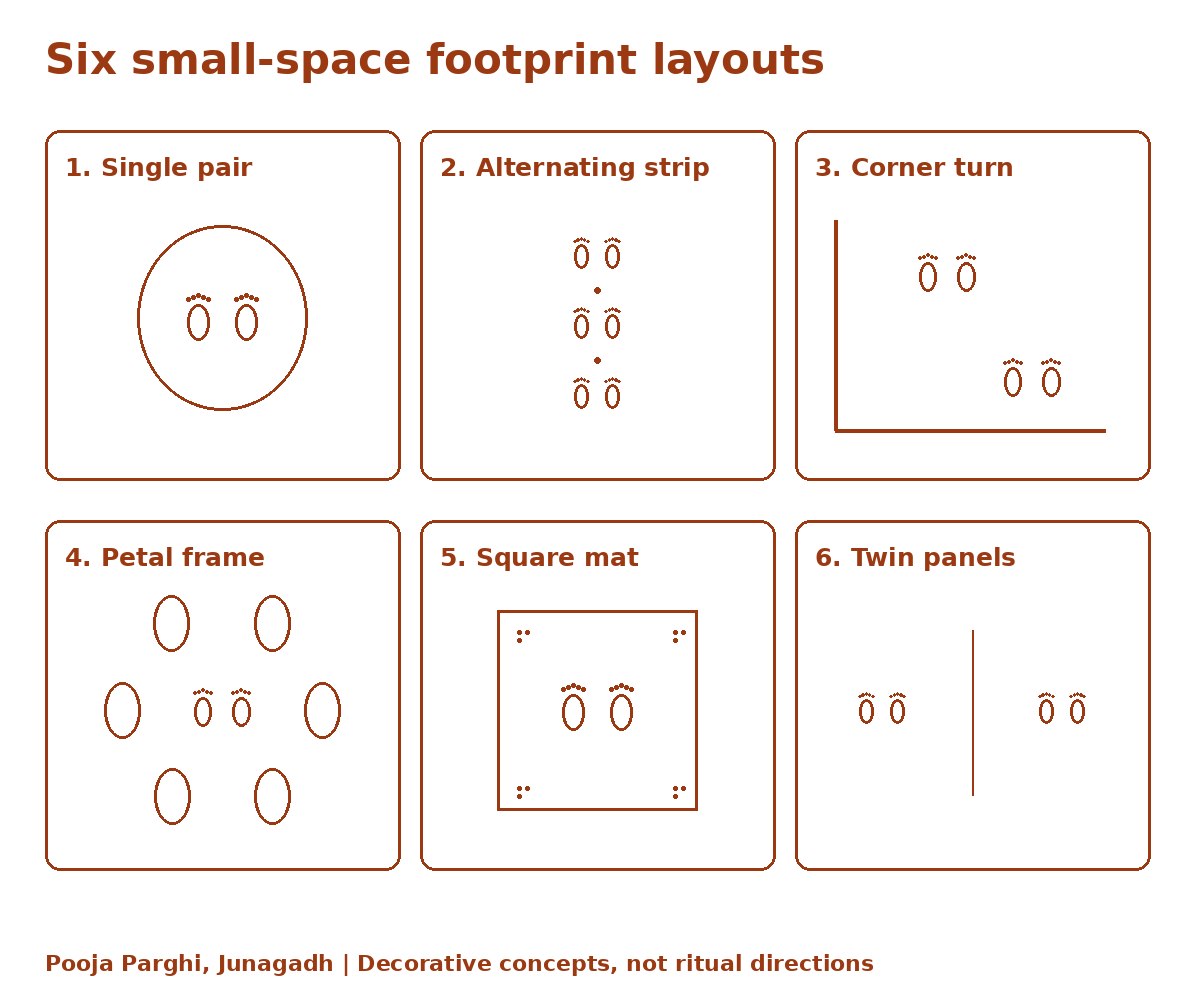
Six layouts to try
- Single pair: one small pair centered inside a thin oval.
- Alternating strip: three pairs with a dot between each pair, placed beside the threshold.
- Corner turn: two pairs arranged along an L-shaped border.
- Petal frame: one pair surrounded by six simple petals.
- Square mat: one central pair with dot clusters at four corners.
- Twin panels: one small motif on either side of the doorway, leaving the center clear.
These are original decorative layouts, not a claim about a required ritual direction. Follow your own household tradition if it specifies placement.
1. Set a boundary you can keep clear
Sketch a light boundary for the whole pattern. Leave enough room for the door to move and for normal walking. For twin panels, check both sides separately; a bag, shoe rack or wall projection may make one side narrower than the other.
Check: The design sits outside the route people need. No edge of a step is hidden, and the door will not sweep through the pattern.
2. Make one pair before repeating it
Draw the two sole shapes on paper and add a simple toe-dot cluster. Compare them from standing height. Keep the footprint pair recognizable before adding petals, circles or extra pairs. A paper guide helps repeat the same size without redrawing each shape from memory.
Check: The main pair reads clearly on its own. If the toe dots merge visually, make fewer decorative details around them rather than adding more powder.
3. Fill the large shapes, then the details
Place the main pair first, fill the sole shapes, then add toe dots and the outer border. Work from the central motif toward the edge so your hand does not repeatedly cross finished sections. A clean open border can be more effective in a small space than several crowded rings.
Check: There is visible white or empty space between the main motif and border. Your hand can reach unfinished areas without disturbing completed ones.
4. Step back and do the entrance test again
Look from the normal approach to the doorway, not only from directly above. Open the door again without walking through the pattern. Remove spilled material promptly. If the space has become crowded, simplify the border or move the design instead of accepting a blocked entrance.
Check: The layout remains clear from standing height and the walking route is still open. No loose powder has spread onto a slippery or heavily used surface.
A narrow-doorway example
If only a short strip remains beside the door, choose the alternating strip and reduce the number of pairs rather than shrinking every detail until it becomes unreadable. If a door would sweep through it, move the whole layout. A smaller intact design is more useful than a larger one that blocks entry.
Lighting and cleanup
Keep open flames away from powder, fabric, paper guides, children and pets. Use unlit or LED accents for a low floor design near an entrance. Clean spilled material promptly and avoid placing loose powder on a surface that becomes slippery. Do not leave a design where it hides the edge of a step.
Practice variation
Try the same one-pair outline with a dot border, a petal border and a plain open border on paper. Compare which stays clear from standing height. Pick one and repeat it; using every color and motif at once usually makes a small space harder to read.
Troubleshooting small-space patterns
The toes look like one blob: practice wider spacing on paper, then reduce surrounding detail. Do not keep making the whole design smaller to fit another border.
The alternating strip feels crowded: use two pairs instead of three. The layout is an idea, not a minimum count you must fit.
The door catches the edge: move the design outside the sweep. A repeated repair in the same place will not change the door's path.
The two side panels do not match: compare their boundaries before filling. If the available spaces are different, choose one corner motif rather than forcing two equally large panels.
The surface marks during the test: stop and use a different suitable display surface. More decoration will not make an unsuitable material easier to remove.
Frequently asked questions
Which layout is easiest for a beginner?
Start with the single pair inside a thin oval. It has one main motif and a simple boundary. Practice it on paper before attempting repeated pairs or a petal frame.
Must the footprints point in a particular direction?
This guide does not set a ritual direction. The six diagrams are decorative layout ideas. Follow your own household tradition for symbolic placement and keep the physical walking route clear.
Can I make it with only one colour?
Yes. A single colour makes it easier to focus on shape, spacing and a clean border. Contrast with the chosen display surface matters more than filling the pattern with many colours.
What if my entrance is extremely narrow?
Do not force a floor pattern into the passage. Use a small removable display board in a safer position or choose another display area. The decoration should fit the entrance, not the other way around.
Do I need exactly five toe dots?
The drawing exercise here uses five dots as a simple stylized footprint. It is a design guide, not an anatomical drawing or a statement that every decorative variation must have identical details.
Can I put diyas beside it?
For a low design near an entrance, unlit or LED accents avoid adding an open flame to a busy floor area. Keep flames away from powder, paper guides, fabric, children and pets.
How can I stop a small design from looking crowded?
Keep one main motif, one border and deliberate open space. Reduce the number of repeated pairs before shrinking the toe dots or adding another ring.
Are these traditional patterns copied from an artist?
No. These are original layout suggestions made for this guide. They are not presented as a quotation, a specific community's prescribed ritual diagram or somebody's photographed work.


Comments
Post a Comment